
The Loneliness Paradox: Transforming Isolation into Empowered Solitude After 50
We often talk about the “Golden Years” as a time of social connection and leisure. But for many in their 50s and 60s, the reality is a phenomenon known as the Loneliness Paradox. Even in an age of constant digital connection, many midlifers feel more isolated than ever as children move away, careers transition, and social circles naturally shift.
As a Senior Health Specialist, I’ve seen that chronic loneliness isn’t just a heavy feeling—it’s a physical health risk. Research suggests that prolonged isolation can be as damaging to your health as smoking 15 cigarettes a day. However, there is a powerful antidote: learning to transform painful “Isolation” into empowered “Solitude.”
1. The Biological Toll of Social Isolation
Human beings are neurobiologically wired for connection. When we feel socially disconnected, our brain’s “threat detection system” goes into overdrive. This increases the production of Pro-inflammatory Cytokines and keeps our nervous system in a state of chronic stress.+2
In midlife, this inflammation can accelerate cognitive decline and increase the risk of cardiovascular disease. Loneliness is not a character flaw; it is a biological signal—much like hunger or thirst—telling you that your “Social Battery” needs recharging or, more importantly, a new type of connection.
2. From “Loneliness” to “Empowered Solitude”
There is a profound difference between being lonely and being alone.
- Loneliness is a state of lack; it is marked by a sense of being forgotten or disconnected.
- Solitude is a state of abundance; it is the ability to be alone with oneself without feeling empty.
One of the most important psychological milestones of the 50s and 60s is mastering the art of Solitude. When you embrace solitude, you stop viewing time alone as a “sentence” and start seeing it as a “sanctuary.” This shift reduces cortisol and allows for the deep reflection that is necessary for midlife growth.
3. A Case Study: The “Social Audit”
I worked with a 62-year-old client named Robert, who struggled with a profound sense of emptiness after retiring. He felt he had no “purpose” because his social identity was tied entirely to his office. He spent his days scrolling social media, which only increased his sense of exclusion.
We conducted a “Social Audit.” Instead of trying to “get back” to his old life, Robert began volunteering at a local community garden—not just for the activity, but to find a “Tribe” with shared values. Simultaneously, he started a daily “Silence Practice” (Solitude) where he sat without distractions for 20 minutes. Within months, he reported feeling more “connected” to himself than ever before. He transformed his isolation into an opportunity for rediscovery.
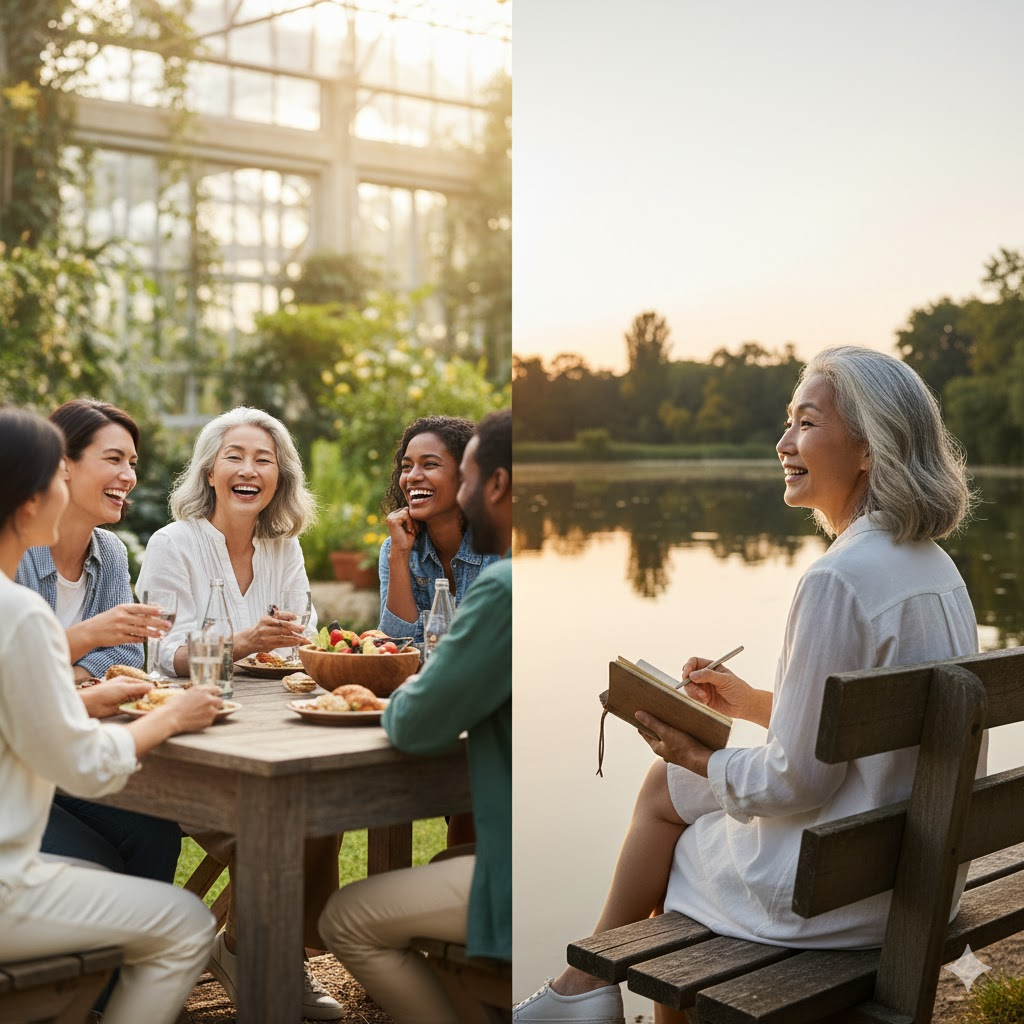
4. Reclaiming Your Social and Personal Connection
To overcome the Loneliness Paradox, consider these three specialist-led strategies:
A. Prioritize “High-Quality” Interaction
In midlife, the quantity of friends matters less than the quality of connection. One deep, vulnerable conversation is more biologically beneficial for your brain than a hundred “likes” on social media. Seek out “Deep Connection” groups—book clubs, hiking groups, or volunteer organizations.
B. The “Volunteering” Neuro-Boost
Helping others triggers the release of Oxytocin (the bonding hormone), which acts as a natural buffer against stress and loneliness. It provides a sense of “Eudaimonic Well-being”—the happiness that comes from having a purpose greater than oneself.
C. Cultivate an “Inner Life”
Build a relationship with yourself. Engage in hobbies that require focus and presence, such as painting, gardening, or woodworking. When you are deeply engaged in a task you love, “Loneliness” vanishes, replaced by a state of “Flow.”
A Final Thought: The Strength of the Self
The second half of life is an invitation to move from external validation to internal peace. While we must remain socially active to protect our brains, we must also become “self-sufficient” in our joy. Loneliness is the call to reach out; Solitude is the call to reach in.
You are never truly alone when you are in good company with yourself.
About the Author
[Better-mind] is a Senior Health Specialist with a focus on geriatric psychology and social wellness. With over 20 years of experience, they help individuals navigate the complex emotional landscapes of midlife and aging, specializing in the transition from career-driven life to purpose-driven longevity.