
Yoga for Longevity: How to Master Your Balance and Prevent Life-Altering Falls
As we enter our 50s and 60s, we often prioritize heart health or weight management. However, there is a “silent” metric of longevity that is often overlooked until it’s too late: Balance. Statistically, a single fall in later life can be a pivot point that changes a person’s health trajectory forever.
As a Senior Health Specialist, I’ve found that Yoga is not just about stretching; it is a sophisticated system of “Neuromuscular Training.” It teaches your brain and body to communicate with precision, creating a “safety net” that protects you in the real world.
1. The Science of Proprioception: Your Sixth Sense
Why do we lose our balance as we age? It’s often due to the decline of Proprioception—your body’s ability to sense its location, movements, and actions without looking. This sense relies on receptors in your joints, muscles, and the Vestibular System (inner ear).
Yoga challenges these systems by moving the body into varied planes of motion. When you stand on one leg in “Tree Pose,” your brain is forced to process a flood of sensory data to keep you upright. This strengthens the neural pathways between your feet and your brain, making your gait more stable on uneven sidewalks or in dimly lit rooms.
2. Combatting Sarcopenia and Bone Density Loss
Falling is often a result of Sarcopenia (age-related muscle loss). Without functional strength in the core, ankles, and glutes, your body cannot “catch” itself if you trip.
Yoga involves “Isometric Contractions,” where you hold a pose against gravity. This type of weight-bearing exercise is critical for maintaining bone density and building the stabilizing muscles that act as your body’s internal scaffolding. A strong core isn’t about aesthetics; it’s about spinal protection and upright stability.
3. A Case Study: The “Near-Miss” Wake-Up Call
I worked with a 64-year-old client named Thomas who had a “near-miss” fall while hiking. He realized his reactions were slower and his ankles felt “wobbly.” He was becoming fearful of walking on trails he used to love.
We started a twice-weekly “Balance-Focused Yoga” routine. We focused on foot grounding and core activation. After three months, Thomas didn’t just feel more stable; his confidence returned. He recently completed a 5-mile hike, noting that his body instinctively adjusted to the rocks and roots. He didn’t just gain balance; he regained his freedom.
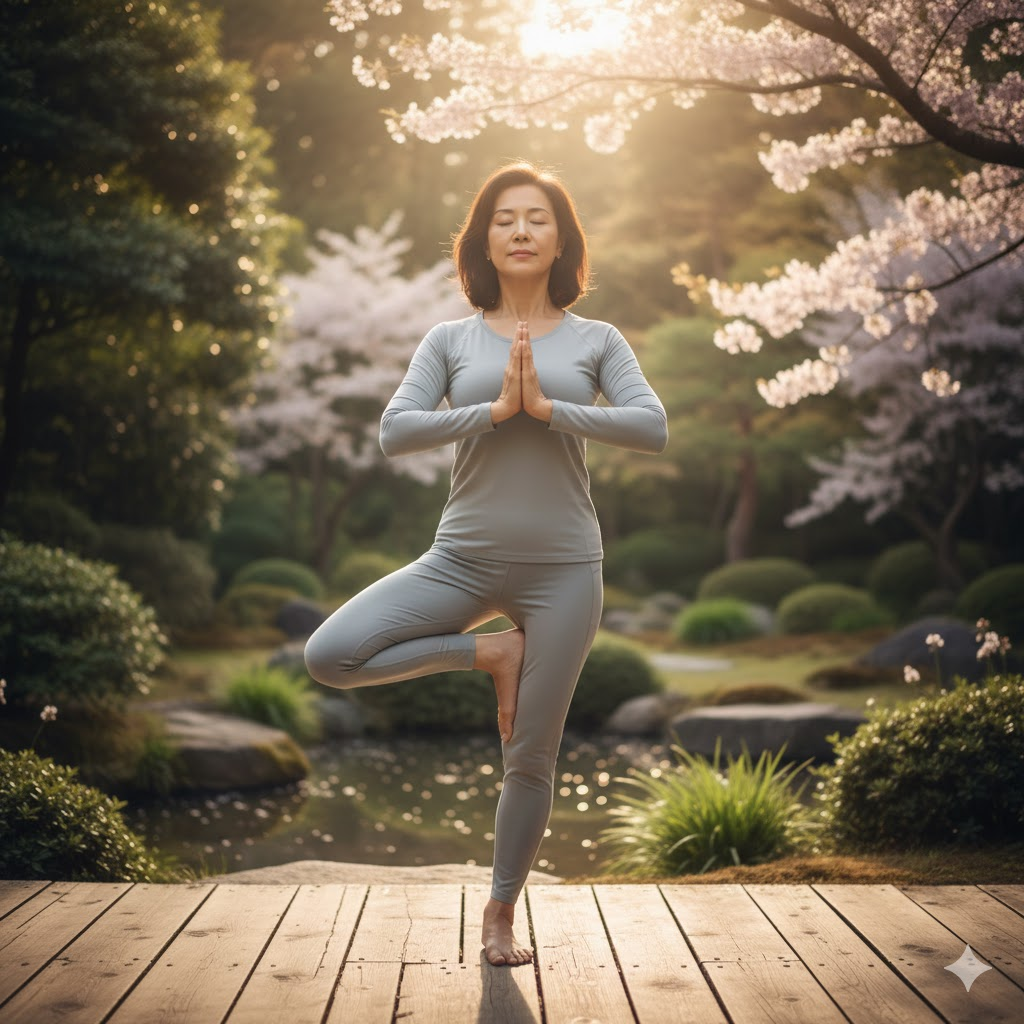
4. 3 Essential Poses for Fall Prevention
You don’t need to be “bendy” to start. These three poses offer the most “bang for your buck” for midlife balance:
A. Tree Pose (Vrksasana)
Standing on one leg is the gold standard for balance training. Keep a chair nearby for support. This pose strengthens the ankles and trains your gaze (drishiti) to stabilize your nervous system.
B. Warrior II (Virabhadrasana II)
This pose builds immense strength in the thighs and glutes while opening the hips. A strong “base” is your best defense against losing your footing.
C. Mountain Pose (Tadasana) with Eyes Closed
Standing still seems easy, but closing your eyes removes visual cues, forcing your brain to rely entirely on your inner ear and foot receptors. It is a masterclass in proprioceptive training.
A Final Thought: Balance is a “Use It or Lose It” Skill
In the second half of life, your agility is your autonomy. Yoga provides a low-impact, high-reward method to keep your “internal GPS” calibrated and your muscles ready for action.
The goal of yoga isn’t to touch your toes; it’s to make sure you can stay on them. Start today, one breath and one step at a time.
About the Author
[Better-mind] is a Senior Health Specialist and certified Yoga instructor with a focus on functional movement for aging adults. With over 20 years of experience, they specialize in fall prevention and helping midlifers maintain their physical independence through mindful movement.